

Temporary shading factor
Modelling the benefits of blinds, shutters and foils

The temporary shading factor is often missed in PHPP modelling. You might've seen it in your PHPP and wondered what it is, but never really understood it or why you should use it. Let’s explore why it’s important for Passivhaus design.

Solar gains are one of the biggest energy gains in a Passivhaus building. As such any measures to optimise the amount of solar gain is important for good Passivhaus design.
Mitigating any overheating risk through minimising unwanted solar gains during summer is vital to ensuring good occupant comfort throughout the year.
All Passivhaus buildings must have a cooling demand lower than 15kWh/(m²a) and must have less than 10% of operating hours above 25°C (preferably 5% for good practice).
One of the ways we can achieve these targets, and solve the problem at source, is through blocking the incoming solar energy. This can be done with simple shading devices such as blinds, shutters and foils.

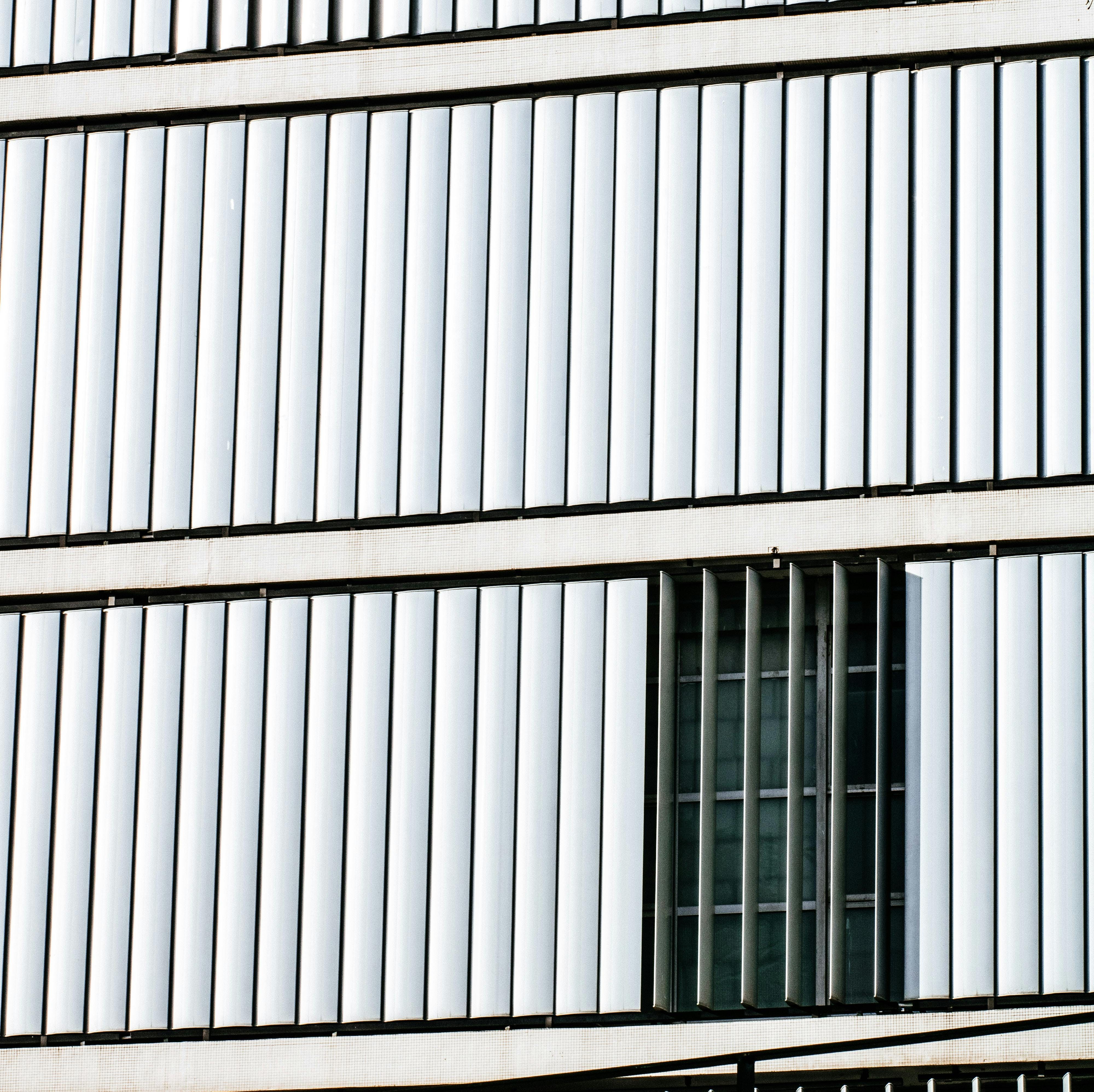
Temporary shading devices are blocking devices, such as blinds, that can be operated by a building management system (BMS) or manually by occupants, that help reduce the solar gain though a window during times in which the building is at risk of overheating.
PHPP allows you to model their effects on your building through the temporary shading factor (z).
The temporary shading factor is the percentage of energy that gets into the building with the shading device compared to without it, and is calculated in a similar manner to the summer and winter reduction factors outputted from designPH. A lower number indicates a more effective shading device, a higher number means more energy gets past.
Let’s dig into temporary shading devices and how to model them in your PHPP energy model.

In buildings that are unlikely to overheat due to a cold climate there really isn’t much value in modelling this until asked to by the certifier, so leave this blank or at 100%. PHPP doesn’t apply the impact of temporary shading to the winter case so it won’t affect the critical space heating demand result.
In hot climates however, this is an important one to model before going into technical design. If your building is using energy for cooling this one is good to get in at an early stage as it will affect the space cooling demand. The PHPP manual has some default assumptions that can be used but we’ll come onto this later.
If at any point during design your building starts to become at risk of failing the frequency of overheating target, this becomes important to model. This applies in all climates, but is more likely to occur earlier in the design process in warm climates and later in the technical design for cool climates.
For buildings that are failing the overheating criteria, installing temporary shading can make a huge difference.
Automatic exterior blinds or shutters are the best solution as they block the incoming solar energy outside of the thermal envelope. You can achieve around a 50% reduction in the frequency of overheating by adding them on all windows. Depending on site specific geometry you can achieve a 60% reduction in space cooling demand if the building is being mechanically cooled.
By including manually operated interior blinds the effect is far less pronounced but not to be sniffed at. You can expect around a 20% reduction in the frequency of overheating by including them on every window. If mechanical cooling is installed space cooling demand can reduce by around 15%.

Firstly you’ll need to know what sort of shading device is being installed on every window. You should be able to get this information from the project architect. If you have a variety of different shading devices, your certifier may ask for a mark-up of which shading devices are installed on which windows.
Remember, as a Passivhaus consultant, if the temporary shading becomes critical to the design you can always recommend specific styles of shading device to the architect to help meet the Passivhaus standard. As you’ll see below, just by changing the colour of a roller blind system you can get a small but useful benefit.
Once you know what devices are to be installed, there are some default temporary shading factors to use in the PHPP manual for double and triple low-e glazing. They can be found in Table 13 on page 234 but here’s a copy to save you digging:
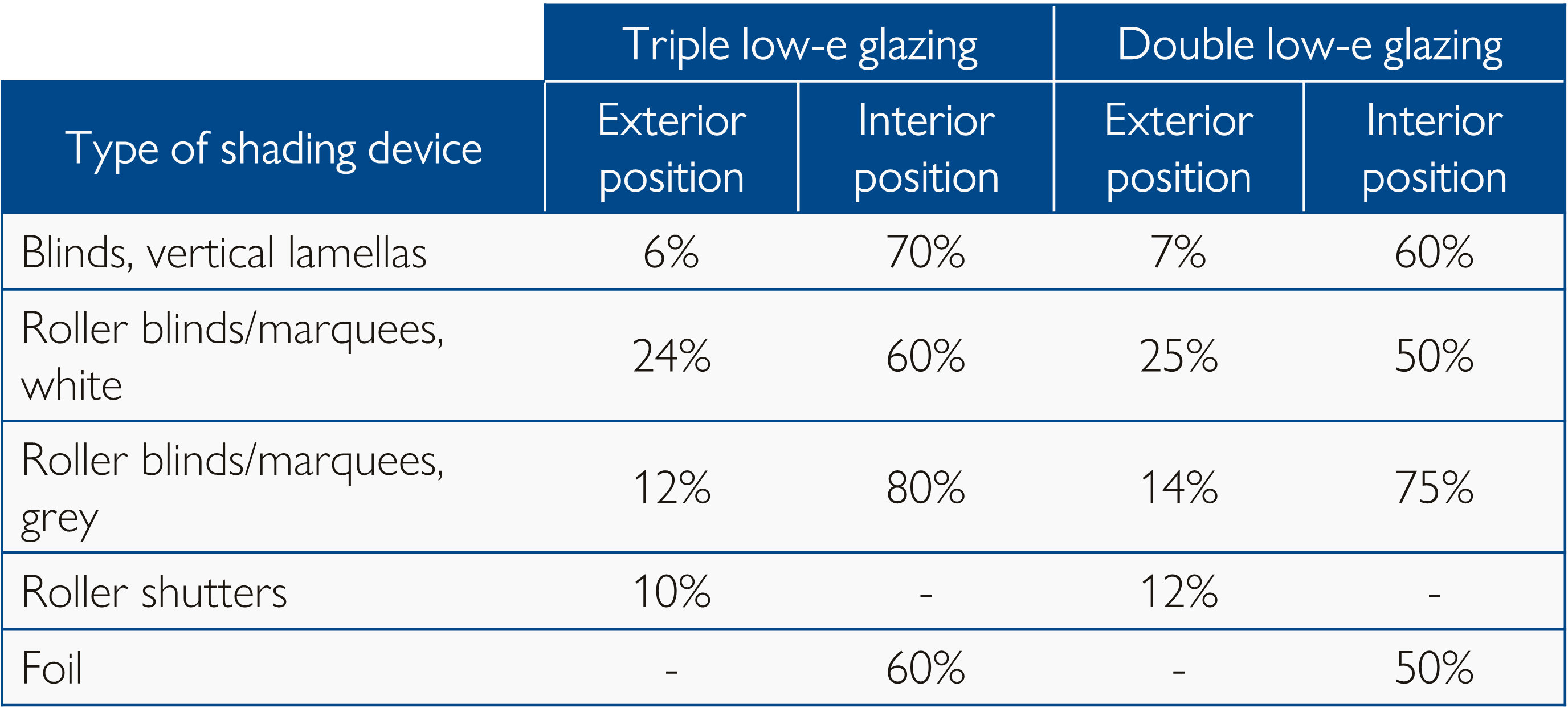
If your device doesn’t fit the description of any of the above, occasionally window manufacturers may give the g-value of a window system for its shaded and unshaded state. This can be entered into the temporary shading column as the ratio of the shaded g-value / unshaded g-value. You’ll be able to find these in the specific product data sheet or you can directly ask the manufacturer for them.
However the PHI recommends using the methodology outlined in the German standards DIN V 18599-2 and DIN 4108-2 if you don’t have a window unit that meets the low-e specification in the table above. You will need to collect datasheets as evidence for your certifier.
PHPP will automatically calculate how often the temporary shading is used. It assumes that 70% of the shading is used when calculating cooling demand as people are somewhat likely forget to close shading devices, especially if the space feels cool through active cooling. A good way to think about this is as a 70% efficacy of the device.
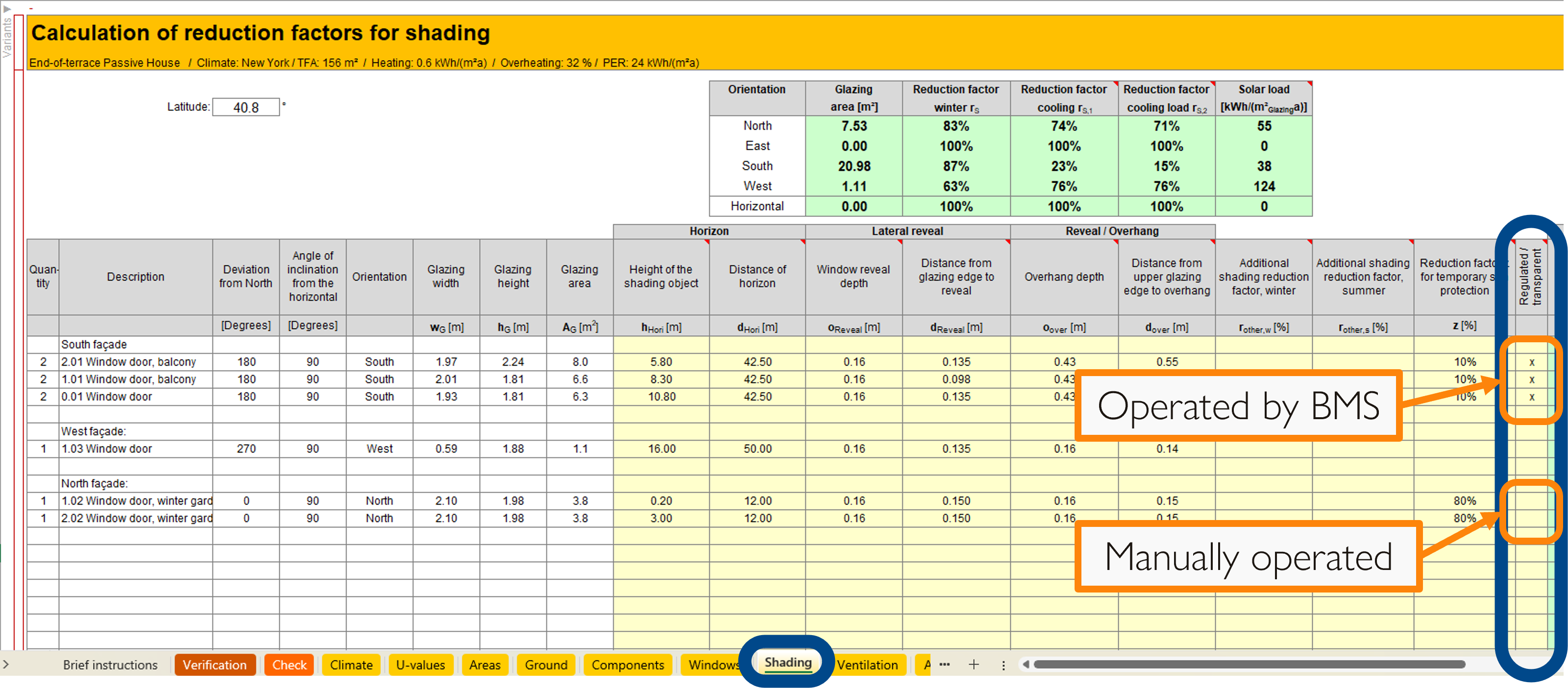
If the shading is automatically controlled by a BMS system or if the device is transparent, you’ll need to mark the final column in the shading input table with an ‘x’ so that PHPP calculates with 80% efficacy, slightly better than leaving it up to an occupant to react to feeling uncomfortable.
When calculating the overheating risk and cooling load (the limit case), PHPP assumes a 90% efficacy because in the worst-case conditions both users and BMS are more likely to react and operate the shading devices.
A quick note on good practice
In non-residential buildings, automatically controlled blinds are especially helpful as they can operate during unoccupied hours such as at weekends to help reduce the solar load. However, when the building is in use these can lead to complaints as occupants lose control over their environment. To mitigate this, the commissioning and regular maintenance of controls is recommended.

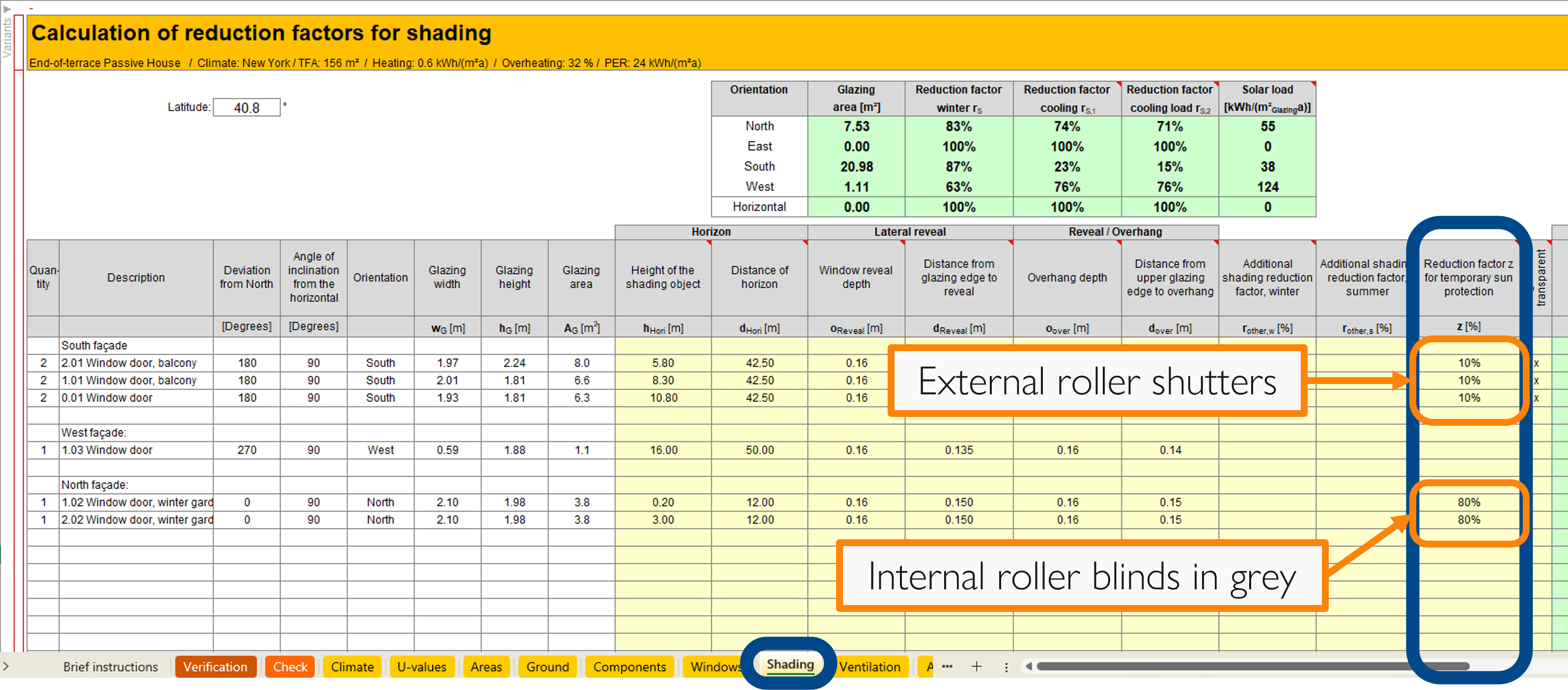
The temporary shading factor is entered in the Shading worksheet in PHPP.
The shading factor for each window is entered into the column labelled “Reduction factor z for temporary sun protection” (column AJ in a standard PHPP).
The “Regulated/transparent” column (column AK in a standard PHPP) is to be marked with an “x” or left blank. This can be selected from the dropdown in each cell or just typed.

Hopefully you now know how to model the benefits of blinds, shutters, foils and other temporary shading devices in PHPP, but here’s a quick summary
WHY: To reduce overheating risk and cooling load
WHEN: At an early stage for warm climates where buildings have a significant cooling load, otherwise when at risk of failing overheating criteria
HOW: Use default factors for types of shading device from the PHPP manual, otherwise manufacturer data that meets the standards
WHERE: Enter the data in the shading tab of PHPP

Passivhaus Preceptorship bridges the gap between qualification and practice, by guiding and mentoring you, step-by-step, through your first Passivhaus projects. If you find this content valuable, please help spread the word by sharing.

Keep up to date with all of our latest posts by subscribing and have a peruse of all the posts in our archive.