

Thermal mass
How to model the specific heat capacity of your Passivhaus

Thermal mass is an interesting topic. You will likely have heard of it when studying building physics or environmental design but it’s not a topic that’s often brought up in the Passivhaus space. Nevertheless, it’s still an input required in every PHPP. Let’s explore how to add it to your PHPP model.

The picture below is the fireplace in the house I grew up in. It’s a 400 (ish) year old stone cottage with no wall insulation: freezing cold in winter but lovely and cool in a hot summer. I’ve spent many a winter night huddled around watching the flames, but it was decades before I began to appreciate its design.
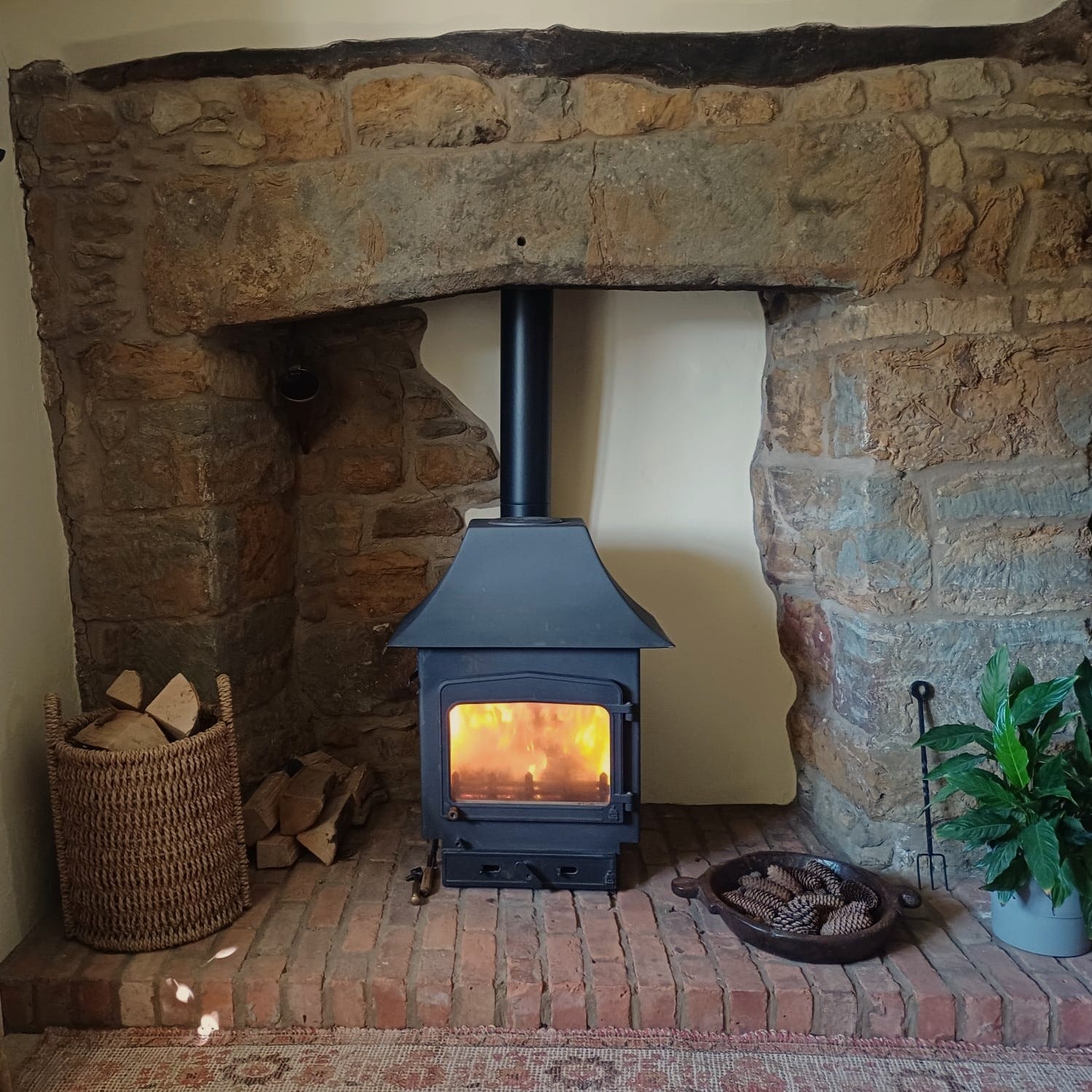
Just look at that massive stone above the hearth. Clever right? If you’re wondering why: it’s thermal mass.
The heat from the fireplace rises and slowly warms the massive thermal battery (the stone lintel) whilst the fire is running. When the fire eventually goes out, that stone spends hours slowly radiating all that stored thermal energy back into the room keeping the space warm for much longer. A nice little solution, if not a bit agricultural, to thermal comfort from the 1600s.
Using thermal mass well can really change the way a building feels during its operation and helps smooth out a lot of the sharper changes in climatic conditions.
In a Passivhaus however, these swings are already somewhat muted by the 20-degree operative temperature easily maintained by the low space heating requirements. But thermal mass still has its place and affects the space heating demand quite a bit.

Thermal mass, or specific heat capacity, is a material’s capacity to absorb, store and release thermal energy. It is a standard input required in every PHPP and accounts for the damping effect of thermally heavy construction.
The specific heat capacity depends on the main exposed materials within the building’s thermal envelope. Materials such as concrete have a greater thermal mass in comparison to lightweight materials like timber and, as such, have a larger damping effect on the dynamic heat transfer.
PHPP is a steady state tool and doesn’t model dynamically but even its steady state modelling method accounts for the benefits of thermal mass. For a PHPP model, thermal mass is measured in Wh/K per m² TFA (the energy stored per Kelvin per square metre of treated floor area).
Let’s have a look at how to model it in your Passivhaus.

As a rule of thumb, it’s best to get a quick assumption into your PHPP at an early design stage, in fact your PHPP won’t produce results without it. For this we can use the values in the note on the input cell in the Verification worksheet to pick a value for either lightweight construction, mixed construction or solid construction.
At technical design stage, once we’re more confident on the exposed materials and finishes, this can be updated with a more accurate calculation.
It’s worth noting that it is better to underestimate the specific heat capacity of your building than overestimate it in both cold and warm climates. A large specific heat capacity reduces the heating and cooling demands of a building. Changing the specific heat capacity can change the heating demand or cooling demand by around 20%, but the magnitude of the effect does depend on the climate file.
For cold climates
Specific heat capacity does not affect the heating load but does affect the space heating demand. This is because heat load is calculated on a worst-case scenario in which thermal mass is conservatively assumed to have no effect. A thermally massive building does reduce the space heating demand due to its dynamic stabilising effect.
So, if you’re targeting heat load instead of space heating demand, you can pretty much stick to a conservative early-stage assumption throughout your design and build.

For an early-stage assumption, I’d just drop in the standard value for lightweight, mixed or solid construction. These are:
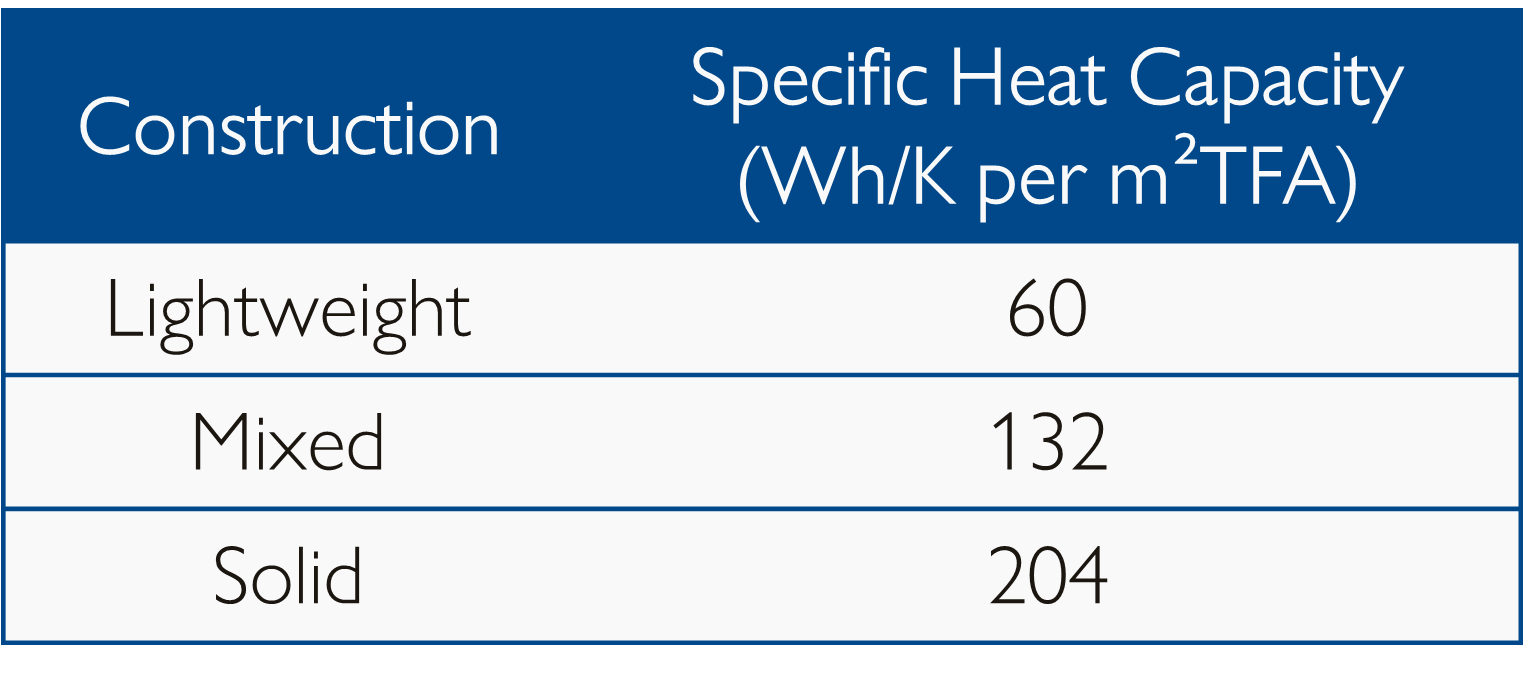
To understand what type of construction your building falls into you’ll need to have a good gauge on what these types of construction are and have an understanding of thermal mass. To give you a better idea of this it’s worth understanding the calculation behind finding a more accurate value for your PHPP model. Hopefully it will give you an intuition of solid construction materials.
But first we need to define a ‘typical room’.
There is no set rule on which room to pick as a typical room. You’ll need to have an understanding of what is typical for your construction. But, if you’re designing a multistorey building, a room on one of the middle floors of the building would be a much better choice than the top floor or a ground floor room. Likewise, if you have a long, thin floor plan, picking a room at the end of the plan with multiple external walls probably won’t be representative of the average.
It is also important to simplify your typical room to a cube. The formula for calculating the specific heat capacity in PHPP has a limit of 6 faces: 1 floor, 1 ceiling and 4 walls. So, any complex geometry in your typical room should be simplified down to get a gauge of the main construction types.
Next, we need to know the construction of all the faces in our typical room. We should only consider materials that are inside the thermal line. For example, if we have a stone façade that has internal wall insulation, the stone cannot be considered as part of the thermal mass as it is outside the thermal line.
For materials that are inside the thermal line, PHPP splits these into 3 different categories: solid, partially solid and lightweight.
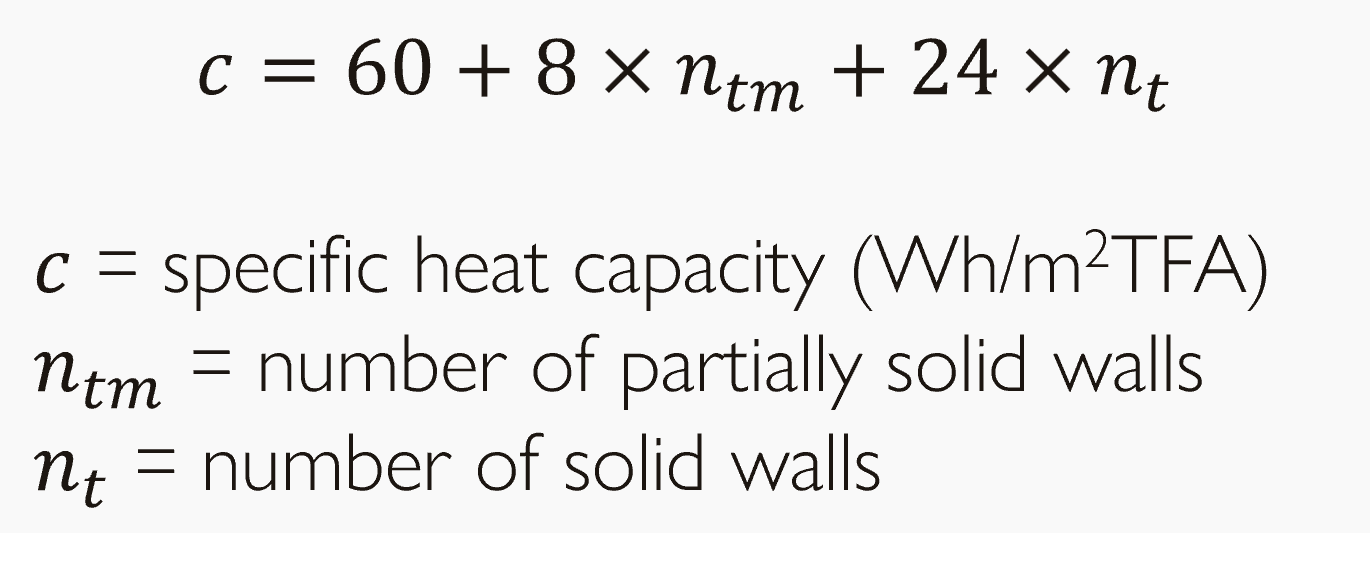
Solid construction includes masonry, stone, brick, concrete and screed (>50mm). These are considered thermally massive and if a face of your typical room is constructed from these an additional 24 Wh/K per m² TFA can be added to the thermal mass.
Partially solid construction includes board stack ceilings, porous concrete and lightweight bricks walls. These have a moderate effect on the thermal mass, and each face of your typical room adds 8 Wh/K per m² TFA to the specific heat capacity.
Other materials are considered lightweight construction and are conservatively assumed not to count towards the thermal mass of the building as they are already accounted for in the base 60 Wh/K per m² TFA figure.
Note: Two sheets of 12.5mm plasterboard are often specified for internal walls. These are considered as ‘half partially solid’ so only add 4 Wh/K per m² TFA to the specific heat capacity for each face that has this specified, or count as 0.5 of a partially solid construction.
So, for your typical room all you need to do is analyse the 6 faces of the room and apply the formula below:
Once you have calculated the specific heat capacity of your typical room, we just need to add it to our PHPP model.

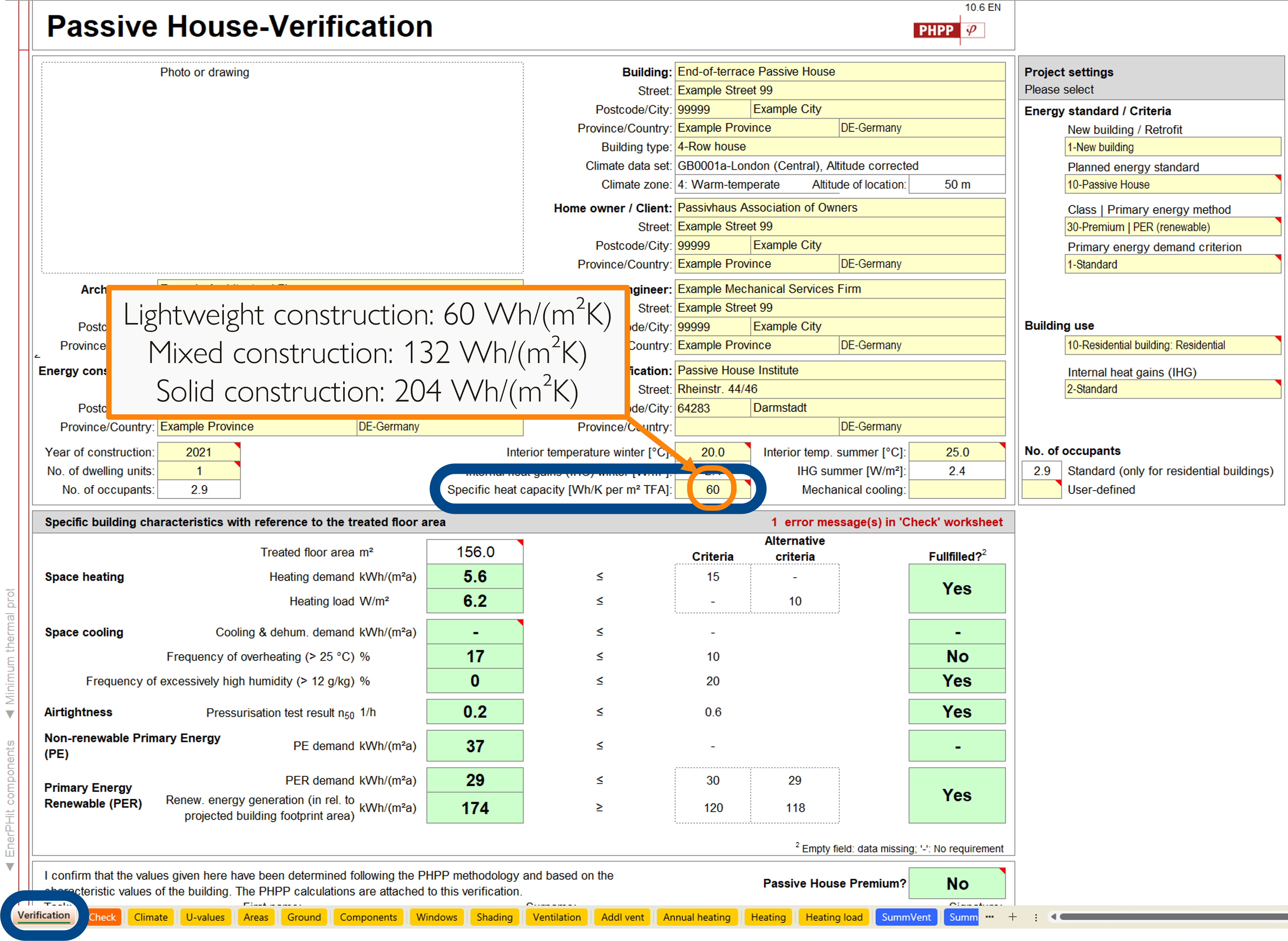
The specific heat capacity value gets inputted into the Verification worksheet in the ‘specific heat capacity’ field, usually cell K30 in a standard PHPP.
If you hover over the input cell, Excel shows you a note including the standard values to input for specific heat capacity at early design stage. Make sure to overwrite this cell at technical design stage once you’ve calculated the specific heat capacity for the ‘typical room’.

Hopefully you now know how to model the effects of thermal mass of your Passivhaus project using either early-stage assumptions or the typical room method.
WHY: Requirement in every PHPP before results are shown
WHEN: Simple assumption at early design stage, detailed number at the start of technical design
HOW: Using the default assumptions, or the specific heat capacity calculation for a ‘typical room’
WHERE: Enter the specific heat capacity in the Verification worksheet

Passivhaus Preceptorship bridges the gap between qualification and practice by guiding and mentoring you, step-by-step, through your first Passivhaus projects. If you find this content valuable, please help spread the word by sharing.

Keep up to date with all our latest posts by subscribing and have a peruse of all the posts in our archive: